
behavior is only half of the story. The other half is emotion. And that's where things become interesting.
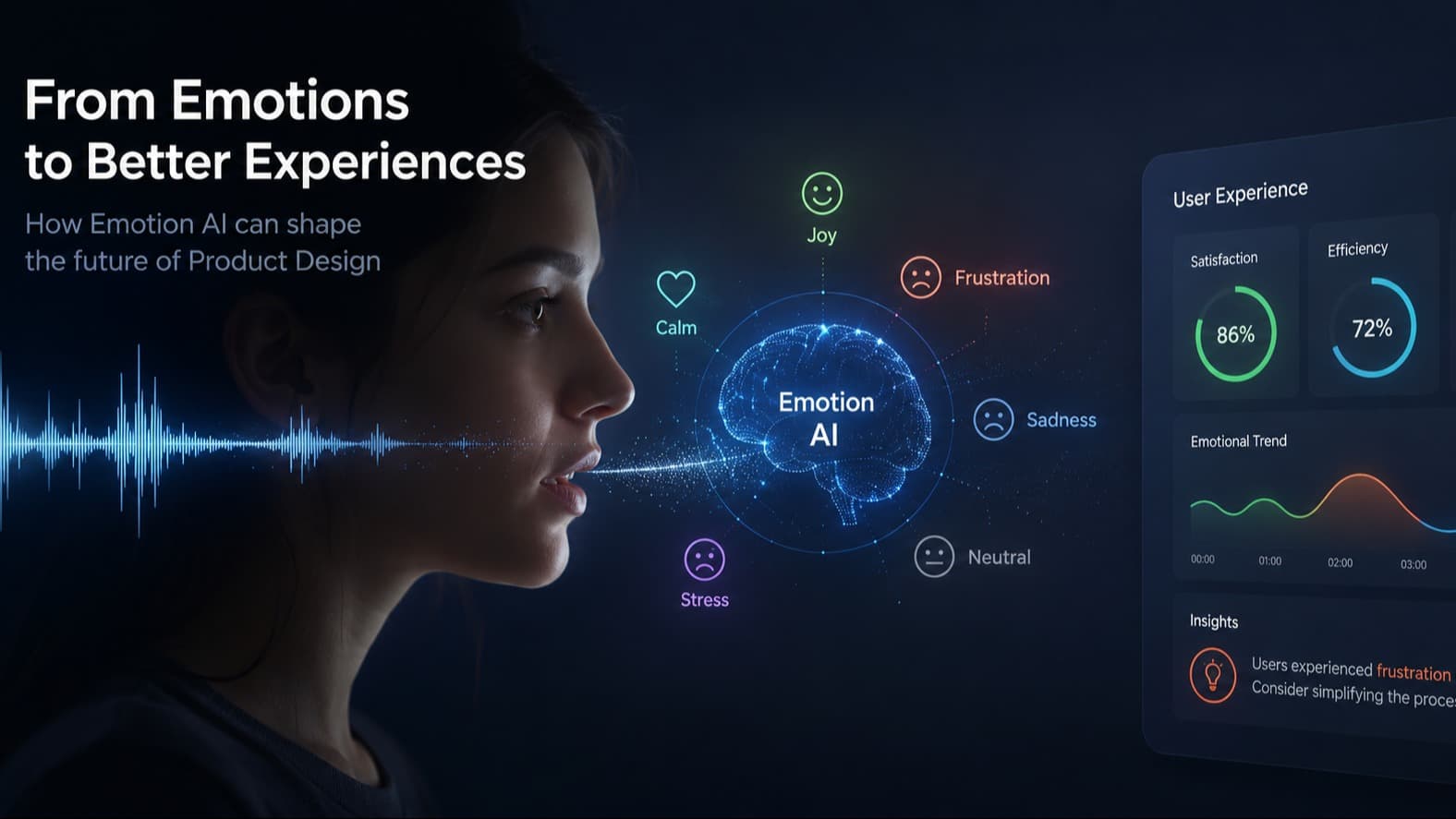
We Measure Clicks. But What If We Could Measure Frustration?
How Emotion AI could change the future of UX and Product Design.
For years, product teams have relied on surveys, interviews, usability testing, and analytics to understand users.
These methods are valuable. But they all share one limitation:
We are always looking backward. We ask users how they felt after the experience is over. We analyze problems after they have already happened.
But what if products could understand how users feel while the experience is happening?
Not after a survey. Not after a support ticket. But at the exact moment frustration appears.
This question led me to explore a fascinating area of AI called Speech Emotion Recognition (SER).
The idea is simple. When people speak, they communicate much more than words. Frustration sounds different from satisfaction. Stress sounds different from confidence.
Changes in pitch, rhythm, pauses, and vocal energy often reveal emotional states that users never explicitly express. Humans naturally pick up on these signals. Today, AI is learning to do the same.
Most conversations around Emotion AI focus on model architectures, datasets, and accuracy scores. But as a Product Designer, I became interested in a different question:
What happens after we detect an emotion? Because detecting frustration is interesting.But understanding what that frustration means for user experience is far more valuable.
Where Could Emotion AI Be Used?
The first applications that come to mind are usually voice assistants and chatbots. But the possibilities go much further.
• Customer Support & Call Centers
Imagine a support system that can detect rising frustration during a conversation. Instead of waiting for a complaint, the system could escalate the call, simplify the interaction, or provide additional assistance in real time. The result isn't just faster support. It's a more empathetic experience.
• Smart Vehicles
Future vehicles may not only monitor road conditions. They may also monitor drivers' emotional states. Detecting stress, fatigue, or cognitive overload through voice could help improve safety, reduce human error, and create more adaptive driving experiences.
• Online Learning Platforms
Students often struggle silently. An emotionally aware learning system could recognize confusion, frustration, or disengagement and adapt content accordingly. Instead of treating every learner the same, the experience could respond to individual emotional needs.
• Digital Health & Mental Wellbeing
Emotional signals in speech may provide valuable context for digital health platforms. While these systems should never replace professionals, they could become powerful tools for monitoring wellbeing and providing early support.
• Next-Generation AI Assistants
Today's assistants listen to what we say. Tomorrow's assistants may also pay attention to how we say it. The difference between a calm request and a frustrated one could fundamentally change how AI responds.
• Adaptive Digital Products
Perhaps the most exciting possibility is products that adapt to users emotionally. A product could simplify complex workflows when frustration increases. Offer additional guidance during moments of confusion. Or reduce cognitive load when stress levels rise.
In this future, products don't just become smarter. They become more human-centered.
From Emotion Detection to UX Measurement
While exploring this topic, I encountered a challenge that most Emotion AI research rarely addresses. Most systems stop at emotion classification.
Happy.
Sad.
Angry.
Neutral.
And that is where the story ends. But from a UX perspective, emotions alone are not actionable. If a system tells us that a user is frustrated, what exactly does that mean for the experience?
Does it indicate low satisfaction?
Poor efficiency?
Reduced effectiveness?
This question became the foundation of my research.
Instead of treating emotions as the final output, I explored whether emotional signals could be mapped to established UX metrics.
More specifically, I investigated how emotions detected from speech could be interpreted through the lens of internationally recognized UX standards.
The goal was not simply to answer:
"How does the user feel?"
But rather:
"What does that feeling tell us about the quality of the user experience?"
This creates a bridge between two worlds that are often disconnected:
AI systems that detect emotions. And UX frameworks that help product teams make decisions.
What I Learned
During this research, I developed a Speech Emotion Recognition model that achieved approximately 88.7% accuracy in identifying emotional states from voice recordings. But surprisingly, the most interesting outcome was not the model's accuracy. The real question emerged after emotion detection:
What can we actually do with these emotions?
Most emotion recognition systems stop at classification.
Happy.
Sad.
Angry.
Neutral.
And that is where the story ends.
But from a product perspective, emotions alone are not actionable. If a system tells us that a user is frustrated, what does that really mean?
Does it indicate poor usability?
Low satisfaction?
Difficulty completing a task?
Or reduced efficiency?
To explore this question, I went one step further.
Instead of treating emotions as the final output, I mapped detected emotional states to three established UX dimensions defined by the ISO 9241-11 standard:
Satisfaction; How satisfied is the user with the experience?
Efficiency; How much effort is required for the user to achieve their goal?
Effectiveness; How successfully can the user complete the intended task?
The idea was simple:
If emotional signals can reveal how users feel, perhaps they can also tell us something about the quality of the experience itself.
For example, repeated signs of frustration, anger, or stress may indicate lower satisfaction, reduced efficiency, or obstacles that prevent users from reaching their goals.
On the other hand, positive emotional states may suggest smoother interactions, greater satisfaction, and more successful task completion. But I didn't want this framework to remain a theoretical assumption. To validate the approach, I compared the system's UX interpretations with evaluations provided by UX experts.
The results showed approximately 79.3% agreement between the proposed mapping framework and expert assessments. While far from perfect, this was an encouraging signal that emotional data can provide meaningful insights into user experience when interpreted through established UX principles.
For me, this was the most important finding of the entire project.
Not that AI can recognize emotions. But that emotions can potentially become a measurable UX signal. A layer of insight that sits between behavioral analytics and traditional user feedback. Today, product teams can easily see what users do.
Perhaps in the future, they will also be able to understand how users feel—and how those feelings influence satisfaction, efficiency, and effectiveness throughout the experience. And that is where Emotion AI becomes truly interesting for Product Design.
The Ethical Challenge
Of course, emotionally aware products raise important questions.
Should products listen to emotional signals?
Where should we draw the line?
How should emotional data be stored?
How do we protect user privacy?
As designers, we cannot discuss Emotion AI without discussing ethics.
The future of this technology will depend not only on its accuracy but also on how responsibly we design it. Because the goal should never be surveillance. The goal should be creating products that better understand and support the people who use them.
The Future of Product Design
For years, the technology industry has focused on making products smarter.
Smarter recommendations. Smarter automation. Smarter predictions.
But intelligence alone does not create meaningful experiences.
Understanding does. Perhaps the next generation of products will not be defined by how much they know. But by how well they understand the people who use them. As Product Designers, we have spent years learning how users behave. The next challenge may be learning how users feel. And that could change everything.
-------------------------------------------------------------------------------
If products could understand user emotions in real time, how would that change the way we design digital experiences?